From the time of the Goguryeo kingdom
(37 BCE- 668 AD), when royal tombs were decorated with murals of figures in
unarmed combat and guarded by statues of ancient warriors, martial arts have
played a prominent role in Korean society. Historians have traced the evolution
of Korea’s martial arts from this era, in which ancient forms such as subak and taekkyeon were practiced, to the mid-20th century, when
modern taekwondo was formed. In 1971, taekwondo was designated Korea’s national
sport, a decision that revealed its importance to the Korean culture and the
Korean national identity. Since then, taekwondo has been recognized as the
world’s most popular martial art. The incredible growth and worldwide
popularity that taekwondo has experienced in the past 40 years has drawn
international interest to the Korean peninsula. This was notably the case in
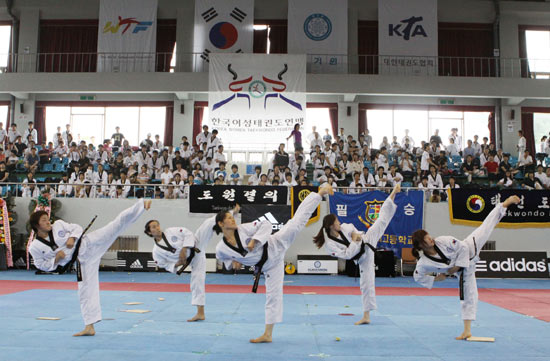
the 1988 Seoul Olympics, and in the work of the Kukkiwon demonstration team as an ambassador of Korean culture. The
spread of taekwondo has led to the spread of Korean culture and to increased
awareness of the small country of Korea, long overshadowed by its giant
neighbors in the far Eastern corner of Asia. More
than just a competitive sport, taekwondo has helped in the globalization of the
Korean culture, and in the redefinition of Korea’s role as a leading member of
the international community.
The
origin of Korean martial arts: hwarang warriors
The taekwondo movement
first appeared on the Korean peninsula long before the development of
taekwondo, with the rise of the hwarang
warriors. Though not solely a military group, these young men became expert
martial artists in Korean forms such as subak,
and would later prove instrumental in the unification of the three kingdoms under
the leadership of the Silla kingdom (Lazore). Much of the scholarly work about
the hwarang, however, emphasizes not only their military prowess and skill in
martial arts, but their close ties to Korea’s religious institutions (Lazore). While
the hwarang curricula itself was based
loosely on Korea’s ancient religions, a defining characteristic of the hwarang
was their unfailing loyalty to the “Five Codes of Human Conduct.” These commandments
were similar in concept to the Confucian and Buddhist ideals that were
prominent among the elite in the Silla dynasty; a member of the hwarang exemplified qualities such as “humanity,
justice, and courage,” while pledging “loyalty to his king, and filial love
toward his parents,” laws which bring to mind the strict hierarchical
relationships in Confucianism (Lazore). The reputation of the hwarang as devout religious seekers led
some members to be regarded as incarnations of the Maitreya, the buddha who was supposed to “demonstrate the path of
virtue” to humans in the future (“Who is Maitreya Buddha”). Due to the uprightness
of the hwarang, the group’s diverse
knowledge of fields such as religion, politics, and martial arts became an
element of their virtuosity, and was tied into the image of the hwarang as “ideal leaders” who had attained
the highest level in “traditional values, ethical and moral standards,
fighting, and religion” (Lazore). The religious practices of the hwarang can easily be compared to those
of the Shaolin monks, who similarly used kung fu and applied the martial philosophy
in their spiritual practice. The hwarang
are essential to any discussion of Korea’s martial arts history due to the role
they played in uniting Korea’s martial arts philosophy with its religious
culture, granting greater cultural significance and meaning to arts like subak.
Furthermore, martial
arts like subak and later taekkyeon were frequently the subjects
in Korean traditional art, demonstrating both the commonality of martial arts
tournaments in Korean culture, in addition to the perception of these arts as
not just a common pastime, but a beautiful tradition to be preserved and
glorified for posterity. As early as the Goguryeo dynasty (37 BC- 668 AD), the Muyong-chong and Kalchuchong royal tombs were decorated with intricate murals of
figures in armed and unarmed combat, supposedly practicing early forms of subak. These fighters were “meant to
protect and amuse the buried king,” hinting at the popularity of martial arts
for both recreation and defense in this early era (“History of Taekkyon”). One
of the most famous Korean paintings from the 18th century—Korea’s
Joseon dynasty—depicts a taekkyeon sparring match in the royal palace (“Origins
of Taekkyon”). This painting portrays peasants, scholars, and government
officials thronging together in the audience, entranced by the intensity of the
tournament. This scene would have been highly unusual in Joseon’s rigidly
hierarchical society; however, in the absence of written records on martial
arts practice in the Joseon era, such paintings provide insight into the
importance of martial arts to Korean culture, as a tradition that was enjoyed
by, and could potentially unite, Koreans from all classes.
Fascinated by the rich
culture and diverse traditions celebrated by the Korean people, American
anthropologist Stewart Culin published a book titled Korean Games after a tour through Korea in 1895 (Capener). Images
of taekkyeon tournaments were heavily
featured in the book, suggesting that Korean martial arts were practiced throughout
the Korean peninsula, and that these arts had great significance to the Korean
people, something even a foreigner was able to identify. The importance of
martial arts to the Korean people, and its place as a tradition representative
of Korea’s culture therefore set the precedent for the development of Korea’s
newest martial art--taekwondo.
The
birth of global taekwondo in the lead-up to the Seoul Olympics
Immediately following
Korea’s independence from Japanese Occupational rule, five different branches
of martial arts sprang up in Korean society (Capener). After 36 years of
“re-education” under the Japanese, in which the Korean people were forced to
think of themselves as “passive,” and “coming from a tradition without a
fighting spirit,” many Koreans turned to the traditional martial arts such as taekkyeon as a means of re-discovering
their national identity and declaring their sovereignty (Harmon 22). The
martial arts practiced in these years were similar to traditional Korean
martial arts, with some influence from the styles of neighboring countries (22).
Starting in the 1950s, however, the leaders of the separate kwans or schools of martial arts came
together in order to standardize Korea’s fighting styles. Through their
efforts, taekwondo—the art of the hand and foot—was born. From its inception, this
new martial art was different from previous ones in its more international
appeal; the International Taekwondo Federation (ITF) and World Taekwondo
Federation (WTF), the first taekwondo organizations with branches in other
countries, declared as their mission the “promotion of taekwondo outside Korea”
and “the expansion and improvement of worldwide taekwondo” (Capener). By the
early 1990s, taekwondo had become affiliated with 19 different regional and
international tournaments in the Americas, Europe, Africa, and Asia (“World
Taekwondo Federation”). However, this did not mean that taekwondo had strayed
from the philosophy that characterized Korea’s former martial arts. On the
contrary, taekwondo philosophy was imbued with much of the same spirit that had
been present in the martial code of the subak-practicing
hwarang warriors; in the official World Taekwondo Federation website, the
taekwondo philosophy is suggested to be hongik-ingan,
meaning the “universal wellbeing of mankind.” The International Taekwondo
Federation similarly references every taekwondo practitioner’s duty to strive
to “build a more peaceful world,” and to champion the causes of “freedom” and
“justice” (International Taekwondo
Federation). As a tradition rooted in the Korean culture and yet aimed at a
broader audience, the global spread of taekwondo has been closely connected to Korea’s
own path toward globalization.
When the nascent World
Taekwondo Federation and International Taekwondo Federation first began
teaching taekwondo overseas, they were acting contrary to the sporting
environment in Korea, where the competition level was “quite low” and its goals
“quite humble” (Sanfilippo). Though
taekwondo continued to spread through organizations like the Pan-American
Taekwondo Union and tournaments like the 1st European Taekwondo
Championships, even becoming an Olympic sport in 1980, Korea was still
considered a minor player in international sports competitions. Many nations in
the Olympic Movement were thus surprised when Korea announced its bid to host
the 1988 Summer Olympics; when the country managed to trounce more experienced contenders
such as Japan and Canada to be elected as the host nation, the decision
“stunned the Olympic world” (“Report on Planning and Organization”). While a
confluence of factors finally contributed to Korea’s success, it is very likely
that the country’s founding and management of a globally-practiced martial art formed
the base on which its bid was established. According to the Official Report on
Planning and Organization, the Secretary-General of the World Taekwondo
Federation, Lee Kum-hong, spent the final few months before the decision was
made, “tour[ing] North and Central America” and leading European nations, to
lend his support to Korea’s campaign. In its released summary of the
preparation period, the Korean government speculated that the global
connections of the WTF president were the reason why many IOC members “began to
show interest in Seoul” as a host city. The 1988 Seoul Olympics were
undoubtedly a great boost to Korea’s sports, leading to improved facilities and
training programs, but they also ignited Korea’s globalization, as Korea
experienced increased global trade, foreign investments, and cultural exchange
in the years following the Games (Sanfilipo). Ultimately, the wide recognition
of taekwondo as an Olympic sport brought Korea—as a new member of the Olympic
movement—the publicity and connections necessary to host an Olympic Games, an
event that was hugely influential in Korea’s globalization, and to gain greater
representation in and the respect of the entire sporting community.
Taekwondo
as an ambassador for the Korean culture
With the Seoul Olympics
as a starting point, the globalization of Korean culture, society, and economy
has depended in part on the global network of taekwondo, in which taekwondo
masters have acted as highly successful ambassadors for the Korean culture. In
this movement, none have been more effective than taekwondo masters in groups
such as the Kukkiwon demonstration
team, which has travelled to over 100 countries since its foundation in 1974. In
the UK, one such performance by the Kukkiwon
team inspired a local blogger to write that the Kukkiwon members had “surpassed their human limits [during the
demonstration]” and met with “thundering applause” (Han). However, this
appreciation and the overwhelming interest in the team have been directed not
only at the members’ taekwondo abilities, but the message they deliver as
representatives of Korean cultural arts. After one such demonstration in
Maryland, the students of a local taekwondo school were inspired to take trips
to the closest Korean Cultural Center, to explore exhibits on Korean culture,
traditions, and the history of the Korea-US Alliance (Citro). In an interview, the
students’ taekwondo instructor expressed great pride at the “love…for Korea and
its famous martial art,” that had been inspired by the demonstration and taekwondo
training, and the students’ subsequent “eager[ness] to visit Korea even once in
their lifetime” (Citro).
Recognizing the great
role that taekwondo has had in stimulating Korea’s globalization, and improving
its image as seen by other nations, the Korea government has recently begun to support
the work of taekwondo masters abroad, encouraging them to expand their
activities to promote the Korean culture. In 2009, the Presidential Council on
Nation Branding summarized its efforts as part of then-President Lee’s global
public relations campaign for Korea. In addition to “sending more taekwondo
performance teams abroad,” the plan has entailed the development of
“taekwondo-related [media],” and release of an “online taekwondo manual” (Kim
126). As the purported goal of the council was to “increase [Korea’s] soft
power,” taekwondo has been an invaluable medium through which the Korean
government has been able to replace any western views of “South Korea as less relevant
or important,” relative to its neighbors, with images of the taekwondo
philosophy being carried out around the world (129). By facilitating and
enhancing the spread of taekwondo as a key component in Korea’s public
relations campaign, the Korean government has taken advantage of the trend
started by the Kukkiwon team, using the martial art as a representation of
Korea historically and in modern times, to help the Korean culture gain
visibility in the global community. One method through which the Korean
government has attempted to do this is by sending taekwondo instructors in
missions to underdeveloped nations. In 2011, one such troop of Korean soldiers was
sent to Haiti with the task of teaching basic taekwondo skills, and “introducing
Korean culture through songs and dances” to local youth (“A Korean Legacy in
Leogane: Taekwondo”). Though the troop also worked for UN construction projects
in the area, the Korean culture classes had a lasting impact on the Haitian
youth, as many students later expressed gratitude to the soldiers for “sharing their
knowledge of a discipline” that unites “self-defense” and “meditation” (“A
Korean Legacy in Leogane: Taekwondo”). As taekwondo has readily come to be
accepted as a true symbol of Korea, the good works of taekwondo masters worldwide,
completed in accordance with the taekwondo philosophy, have inadvertently begun
to shape international perceptions of Korea in its global engagements.
The
taekwondo spirit as the Korean spirit
The role that taekwondo
masters played, as ambassadors of Korean culture, in Korea’s Olympic bid has
already been widely acknowledged by the Korean government; yet the influence of
the taekwondo philosophy in determining the tone of the Olympics is a critical
but often overlooked aspect of this event. In the lead-up to the games, the
Korean government declared the Seoul Olympics first and foremost a venue for international
dialogue, establishing three of the five main goals of the event toward the
fulfillment of a global agenda (“Report on Planning and Organization”). This
agenda included showing “compassion”—the Seoul Games were the first to occur almost
parallel to the Paralympics, granting equal importance to disabled athletes—and
paving the way for “future legacy”—Korea’s successful hosting of the event was meant
to “inspire courage in developing countries… towards national development” (“Report
on Planning and Organization”). Especially in recent years, the Olympics have
become known as a commercial venture and gambit for the hosting nation (for
instance, the 2008 Beijing Olympics was solely focused on presenting Beijing
and its citizens in the best possible light), so many countries were perplexed
by the extent of Korea’s externally focused-goals (“Official Report of the
Beijing 2008 Olympic Games”). However, the reasoning behind this decision is
made evident by a brief examination of the Korean culture, especially in its
connection to martial arts philosophy. Since the reign of the Silla hwarang warriors, the ideal person in
Korean society had been one who sacrificed himself for the achievement of peace
among one’s friends, and demonstrated goodness and virtue. This ideal has
continued into the modern day, with current taekwondo schools placing similar
emphasis on the moral philosophy of inducing peace. Likewise, in the Official
Report on the Seoul Olympics, the Planning Committee attests to “Korea’s
orientation toward peace,” and the “excellence of traditional Korean culture,” as
important factors in the Olympics planning process. To a certain extent then,
it was the beliefs of Korean martial artists, which contributed to the nation’s
“peace-oriented” values that would motivate Koreans to plan their first
Olympics with a beneficent agenda.
Since then, the
taekwondo philosophy promoted and practiced by taekwondo athletes worldwide has
become a central part of Korea’s global image; for instance, taekwondo athletes
in countries that suffer from gender inequality, such as Tajikistan, have been
at the helm of the movement for social justice. Members of the NTKF (National
Taekwondo and Kickboxing Federation of Tajikistan) have ardently spoken out to
“advance the rights and equality of women” in Tajikistan—a country that
historically did not provide women legal protection against domestic violence—through
presentations and by encouraging women to learn taekwondo as a means of
self-defense (Boboev). While a draft law abolishing this practice was adopted
in 2012, taekwondo schools remain a refuge for Tajikistani women, a place where
all athletes are considered equal, and the determination to advocate for social
equity is instilled in every practitioner. Taking into consideration the
previously discussed work of taekwondo instructors in communities in Haiti, it
is clear that the athletes for this martial art have become champions for
social minorities, and supported movements for the “universal wellbeing of
mankind.” As these taekwondo masters have begun to truly taken on the role of
cultural ambassadors for Korea, the worldwide image of Korea has come to
encompass such movements for social advocacy, and Korea has, in turn,
incorporated this advocacy in its own global activities, notably as discussed in
the humanitarian focus of the Seoul Olympics.
With its ties to the
taekwondo movement and adoption of the philosophy, Korea has gained the
opportunity to work closely with international bodies such as the United
Nations, for the achievement of shared international goals. In 2013, in
recognition of the work of the taekwondo peace corps, and the World
Para-Taekwondo Championships, the United Nations Office of Sports and
Development Program (UNOSDP) signed a memorandum with the World Taekwondo Federation,
promising to work towards “common objectives… promot[ing] sport-for-all and
peace” (“UN Special Advisor”). While
this agreement made taekwondo a unique tool in the achievement of the goals of
the UN, it concurrently opened the door for collaboration between Korea and the
UNOSDP. As the headquarters of the WTF, South Korea was invited to host the
UNOSDP’s flagship project, the bi-annual Youth Leadership Program, three times,
more than any other nation. In the past two years, this program has provided
youth leaders from over 20 different nations the opportunity to exercise their
leadership abilities and become initiators of international exchange by engaging
in sports with other globally-minded youth. The partnership between the
international institution of taekwondo and bodies like the United Nations has
thus conveyed on Korea the chance to nurture future world leaders, and gain an
image as a nation conducive to international exchange. Had it not been for the
fortitude of taekwondo masters to battle injustice in countries like
Tajikistan, or the appraisal of world taekwondo leagues as a force for global
change, it is unlikely that Korea would be in the position it is today, as an
invaluable partner to the UN and a firm proponent of social acceptance.
Conclusion
Considering the dual
role of the hwarang warriors as military leaders and religious seekers, and the
worldwide presence of taekwondo instructors, it is evident that martial arts not
only have influenced Korean society throughout history, but also have represented
the globally influential Korean culture. The development of taekwondo
reinforced the importance of Korean martial arts, and it quickly became an
ambassador of the Korean culture, granting the country greater power to move
the international sporting community, and the opportunity to host monumental
events such as the Seoul Olympics. These events globalized Korea’s economy and
society. Taekwondo masters have played critical roles of representing Korean
culture and advocating social equality and worldwide development. Consequently,
they had a profound impact on Korea’s image, and also promoted the country’s
position in international engagements. In order to understand current Korea in
the world, it is critical to recognize the importance of its martial arts
culture, and the philosophy underlining taekwondo.

Works Cited
“A Korean legacy in Leogane: Taekwondo.” Sport for Development and Peace. UNOSDP,
2012. Web. 19 May 2015.
Capener, Steven D. “The History of Modern Taekwondo
in Korea.” Taekwondo: The Spirit of Korea.
n.p, 2001. Web. 16 May 2015.
Citro, Marissa. “World Champion Taekwondo Students
Escape the DC Heat to Befriend Korea.” Dynamic-Korea.com, 2012. Web. 20 May
2015.
Han, Jeon. “Kukkiwon Demonstration Team shows off
Taekwondo moves to the world.” Korea.net, 2012. Web. 21 May 2015.
Harmon, R Barry. “The Origins of Korea’s Martial
Unreadiness.” 5000 Years of Korean
Martial Arts. Indianapolis: Dog Ear Publishing, 2007. 21-25. Ebook.
International
Taekwondo Federation. International
Taekwondo Federation, n.d. Web. 25 May 2015.
Kim, Doug. “Martial Arts and Martial Sports.” The Koreas. Ed. Mary Connor. Santa
Barbara, CA: ABC-CLIO, 2009. 322-331. Print.
Lama Yeshe. “Who is Maitreya Buddha?” fpmt. Foundation for the Preservation of
the Mahayana Tradition, 2015. Web. 31 May 2015.
Lazore, Courtney. “The Hwarang Warriors—Silla’s
Flower Boys.” Dartmouth’s The Quarterly
of East Asian Studies. Dartmouth’s The Quarterly, 2014. Web. 1 June 2015.
Boboev, Parviz. “Martial artists fight gender
discrimination, violence in Tajikistan.” United
Nations Population Fund. n.p, 2015. Web. 21 May 2015.
“Mr. Dae Sung
Moon.” Olympic.org. n.p, 2015. Web.
20 May 2015.
“Organization
and Planning Volume 1.” Seoul Olympics
Official Report. IOC Library, n.d. Web. 22 May 2915.
“Origins of Taekkyon.” Over View. n.p, n.d. Web. 21 May 2015.
“History of Taekkyeon.” Taekkyeon. World Public Library, n.d. Web. 19 May 2015.
Passport to
Korean Culture. Seoul: Korean Culture
and Information Service Ministry of Culture, Sports and Tourism, 2011. Ebook.
Sanfilippo, Jonathan. “Two Decades after the Seoul
Olympics.” The Korea Times, 2007.
Web. 31 May 2015.
Southwick,
Ronald A. “A Brief History of Taekwondo.” Michigan State University, n.d. Web.
15 May 2015.
”Taekwondo.” Korea.net.
n.p, 2015. Web. 21 May 2015.
“UN Special Adviser signs partnership agreement with
the World Taekwondo Federation in Manchester.” Sport for Development and Peace.
UNOSDP, 2013. Web. 19 May 2015.

No comments:
Post a Comment