Monday, July 27, 2015

Life-Hacking: Small Steps toward a Successful Schedule and Career (4.16.14)

“Early to bed, early to rise, makes a man healthy, wealthy, and wise.” But, “those that sleep now can dream, while those that do not can achieve their dreams.” Whether it is from parents, teachers, our peers, or idols in history, we live in a world of increasing pressure to be productive and successful in life. Especially with the continual rise of brilliant new entrepreneurs in the Bay Area, the expectation that we follow in their footsteps surfaces every day. In spite of this, we are never told how to succeed, and the words of role models such as Benjamin Franklin and Ban Ki Moon often deliver contradictory messages. Could there be a secret step-by-step guide to becoming a noteworthy name in history? As author Brian Tracy once stated, “Successful people are simply those with successful habits.” Take a look at the habits of five famous figures, and what it took for them to be revered.
            President Obama has inspired many Americans with his dedication to a daily workout at 6:45 A.M, but the First Lady, Michelle Obama, normally leaves the gym at this time, returning home to pack lunch for her daughters. Her workout includes forty-five minutes of cardio and forty-five minutes of strength training, and she has yet to miss more than a single day at a time. What else can we expect from the founder of the “Let’s Move!” campaign?
Adopting the lifestyle of his mother, a full-time novelist and mother of six children, Anthony Trollope believed firmly in the power of early morning inspiration, and would wake up at 5:30 A.M. to write. During this time, Trollope would sit with a watch in front of his paper, and demand of himself 3000 words by 8:30 A.M. or 250 words every fifteen minutes. At the end of his morning, he would immediately head off to a job in the postal service. Although work under such stressful conditions may seem difficult, Trollope managed to publish forty-nine novels in a period of thirty-five years, with his more famous works such as The Chronicles of Barsetshire making him the most celebrated English writer in the Victorian era.
Most heads of state keep up with the height of technology in their country: not Park Geun-hye. The South Korean president is jokingly called “the notebook princess” for her adoration of the quickly-disappearing art of note taking. From meetings with high-profile leaders, to banquets with other Korean politicians, President Park is never seen without a notepad to jot down points that arise in discussion. This habit has both pleased and annoyed fellow officials, but it allows her to be prepared to deliver remarks at all times.
Many artists will attest to the saving power of a daily cup of coffee, and composer Ludwig Van Beethoven was no different. The first order of business every morning was to make breakfast, consisting of a large jug of coffee with exactly sixty coffee beans. (He often counted out the beans one-by-one himself.) Afterwards, he would pour in an incredible amount of sugar, near filling the cup to the rim, and mix it together with a concoction of very strong, black coffee. Perhaps it was such breakfast habits that contributed to Beethoven’s brilliance at the piano, conducting, and composing, even as a deaf musician.
            Neurologist and psychologist Sigmund Freud is famous for his discoveries on the power of human dreams, but he is also known for his well-groomed appearance. After waking up promptly at 7:00 A.M. each morning, the researcher would eat a light breakfast, and spend an hour at the barber shop, trimming his beard. It was once said of him that, “[Freud possessed] a commanding air… an air of power disciplined. Even Freud’s mustache and beard were subdued to order by a barber’s daily attention.” Freud worked hard to cultivate an image that appeased his patients, and through the daily routine, he created a ritual that eventually became an essential part of this incredible life.

From artists, politicians, and writers, each of these giants possessed completely different habits, personalities, and working attitudes. So what was the secret to their success? Each of them lived strictly by a daily routine that allowed them to leave a unique imprint on the world. In order to make our contribution to society, perhaps it’s time each of us re-evaluate our lifestyles, and organize work and leisure around an unvarying time frame. 

Week 6 Response Paper: Religious Liberty

Respect for equality in the context of religious liberty is a distinctive feature of the American tradition, the modern understanding and application of which has evolved gradually through the experience of the American people in a diverse society. Nussbaum describes several distinguishing principles present in the modern American religious tradition, referencing equality as the unifying focus: nonestablishment of state orthodoxy and separation of church and state are intended to prevent the formation of unequal “in-groups” and “out-groups,” while the special treatment of minorities allows for legal accommodation and affirmative action to ensure fair equality in American society. The decisions in court cases such as Sherbert and Allegheny County successfully defended the “equal freedom…to worship in [one’s] own way” and the need to respect “individual religious choice,” and are central to demonstrating Nussbaum’s point that Americans, throughout history, have made progress in developing a framework through which equal liberty can be manifested in the legal system (Nussbaum 17, 18). This story of progression sharply contradicts Tierney’s suggestion, however, that history and social circumstances, rife with persecution and condemnation of heretical thought, have had a pernicious influence on the concept of equality encapsulated in founding documents such as the US Bill of Rights. In Tierney’s words, national experience has “distorted understanding of the original revelations,” the best solution for which is a return to the intentions of these documents (Tierney 45). There is significant evidence to support this claim; the exclusion of religious minorities such as Quakers and Mormons throughout American history forces one to consider the extent to which American religious institutions were and continue to be unequal. Even Nussbaum acknowledges that restriction of equal treatment occurs when particular denominations—such as extremist Islamic sects—are perceived by the public to be threatening to society. Yet if it is indeed true that the original American tradition of equal liberty has been corrupted by misapplication of the spirit of the founders, the founding national documents would necessarily have to encompass, even surpass the meaning and depth of the modern conception of equal liberty. This notion cannot easily be proven, due to the plurality of differing views that were behind the writing of the texts. One can also account for the controversy over the Establishment and Free Exercise Clauses as revealing the incompatibility of original documents with modern society. Furthermore, Nussbaum suggests that such a reading contradicts with the founders’ intention of establishing a broad legal framework on which new interpretations of fundamental principles would later be founded according to the changing social context, in light of their own refusal to abide by traditional ways of thinking (Nussbaum 30). To declare that American history has caused a backslide in the implementation of the concept of equal liberty, may be to fail to recognize that despite periods of inequality, the American tradition has been so entwined with the advancement of equality and liberty as to make them the distinguishing features of a national religious culture.  

Monday, July 20, 2015

Week 5 Response Paper: Cultural and Group Rights

In the case that a liberal state’s recognition of the rights of a group clashes with its protection of liberal precepts, Barry’s proposal adds greater depth to those of Okin and Kymlicka, in that he establishes as a condition for government intervention, the extent to which a group protects its members’ right of exit (Barry 158). For Okin, the establishment of special group rights to protect minority ways of life is foundational to a multicultural society. This protection should not trump the basic rights of individuals, lest a “double standard” be applied to minority groups, in which their members are not guaranteed the same rights promised to all other citizens in a nation (Okin 19). Ultimately, she urges that states take into consideration “the urgency of…representing less powerful members of [minority] groups” in the enactment of group’s autonomy (23). Kymlicka takes the argument one step further by suggesting that the main goal of protecting group rights is to ensure the development of individual self-respect and an opportunity for meaningful individual choice within one’s own cultural context, therefore justifying the granting of special rights only to internally liberal cultural groups. For Kymlicka and Okin then, the state holds great responsibility in the preservation of the basic human rights of individuals, regardless of their membership in a minority group protected by the state.
This discussion fails to address the existence of the freedom of exit and entry within a group, which Barry emphasizes as the determining factor in the balance of power between a state and its internal communities. According to Barry, states are in effect prohibited from interfering with the illiberal internal practices of a minority group, so long as it is a “voluntary association” which members join and can exit at any time of their own free will (Barry 158). Barry’s opinion is made clear through his reference to a case involving the Church of Christ, in which the Oklahoma Supreme Court intervened in the actions of the Church, only on the grounds that the institution had “impose[d] their will on the unwilling” (159). Barry raises a valid point that is not discussed but essential to Okin and Kymlicka’s establishment of a policy concerning the sovereignty of a minority with illiberal policies. However, his argument also allows for minority groups to exploit their legal status: inherently illiberal groups such as the Orthodox Jews could easily institute laws so burdensome as to offset the nominal right to exit, trapping the members in a situation in which the state is powerless to intervene (159). In the enactment of group rights and privileges, it will thus be the responsibility of the state not only to analyze the group’s adherence to the state’s liberal norms as suggested by Okin and Kymlicka, but also to assess the minority’s actual preservation of the freedom of exit. Only then can the special rights of minority groups, fundamental to multiculturalism, be effectively balanced with the ability of the state to guarantee equal rights and protection to all.
  • To what extent can states inspect the practices of minority groups to ensure that private/informal subordination of women is not occurring?
  • If a nation as a whole possesses the illiberal characteristics that the authors attribute to minority groups, does the international community have the responsibility/ability to intervene? In this case, can the right to leave/return to a country be seen as parallel to the discussed freedom of exit?

Sunday, July 19, 2015

Short Paper: Concerning the Question of "Religion"

The use of “religion” as a distinct category of contemporary human rights instruments has raised several significant objections, concerning the nature of religious rights and the possibility for religion to be incorporated into the pre-existing legal structures protecting the rights guaranteed to every person.
            Sullivan disputes the granting of specific legal protection to religious beliefs, sects, and practices for the purpose of defending religious rights, for she claims that this arrangement demands a formal and ultimately exclusive definition of the concept of religion. In order to protect religious rights, the US government in the past has drawn a clear line between institutionalized religion, and informal cultural practices. This boundary—which Sullivan considers a tenuous divide—separates “high religion” (that which is mandated by religious law and outlined in religious texts) from “low religion” (cultural practices that develop without legal backing), and “lawful” practices from “unlawful” ones, as interpreted under legal rights instruments (Sullivan 146). The author responds to this division by referencing the Warner v. Boca Raton case (2004), in which the plaintiffs’ religious activities, rooted not in “high religion” but their family traditions, were dismissed by the court as a matter of personal preference. As Sullivan suggests, the court’s continuing failure to acknowledge the “lived,” transient, and local nature which characterizes the majority of religious practices in the US led to its denying legal protection to a noninstitutionalized but completely valid tradition, violating the constitutional guarantees of religious equality and freedom (143). Even if the government attempted to expand the definition of religion to include “all self-described religiously motivated behavior,” this would lead to the preference of those who claim to be so-motivated over professed nonbelievers, shifting but not eliminating religion-based social distinctions (151). As the specific legal protection of religious rights leads to discriminatory classification on religious grounds and the subversion of the fundamental rights to religious equality and freedom, Sullivan urges for the removal of religion as a distinct category of human rights.
            Gellman and Friedman similarly oppose the independent establishment of religious rights by raising concerns that the protection of these rights as a separate category in legal instruments does not prevent government alignment with a single religion. The authors provide countless cases in which government religious expression created a “marginalization effect” toward minorities in the US, through “the unspoken message to the majority Christians that they were the real Americans” (Gellman,Friedman 671). Gellman and Friedman’s proposal that the Equal Protection Clause, as the main tool used in most cases of human rights violations, be applied to religious rights clarifies their belief that this separation of religious rights from other rights is responsible for legal and administrative problems associated with religious rights law. They offer the aforementioned solution as a means of not only categorizing religious rights within the broader framework of rights, but also eliminating the occurrence of minority exclusion due to government religious expression.
            While the above authors raise two significant objections to the current establishment of religion as a distinct category of religious instruments, I will now focus on a few assumptions they make which undermine the strength of their arguments. Sullivan bases her concern as to the inherently discriminatory nature of religious rights laws on the belief that religious rights instruments encompass religion from a holistic standpoint. Gellman and Friedman, on the other hand, treat as a fact the parallelism between religious rights and other basic rights, and cite a limited number of factors as proof of the insufficiency of relevant legislation.
            In her paper, Sullivan takes note of a unique quality of religion, stating that “to be religious is...to live without a certain amount of freedom...not to be free, but to be faithful” (Sullivan 156). This sometimes antagonistic relationship between religion and freedom sets religious rights apart from fundamental human rights such as the right of freedom of speech, movement, or association. Religious rights can also be distinguished from rights concerning race, gender, economic and ethnic background due to the element of choice contained within religion (choosing which religion, or none, to follow). Because of this difference, the fundamental human rights of freedom of belief and freedom to change one’s religion (UDHR Article 18) are only protected under the jurisdiction of religious rights. Therefore, it is imperative that these rights are acknowledged as universal rights, and placed in a separate category tailored to the unique characteristics of religion.
            Under the framework of human rights, religious rights do not necessarily encompass the entirety of the concept of religion. In fact, they encircle only the social elements of religion which affect the society at large or the interactions between and among adherents and nonadherents of a particular faith. The narrow scope and society-based focus of religious rights are characteristics shared by all human rights; this can be seen in international human rights instruments such as the Universal Declaration of Human Rights and the Declaration on Intolerance and Discrimination based on Religion, which make mention of the “spirit of brotherhood” that should exist between all persons and the freedom to “manifest [one’s] religion… individually or in community with others,” respectively. It is important to note that the individual religious rights referenced in the latter document do not contradict the observed social quality of human rights, as they imply the rights of an individual facing the community. Due to their social focus, all human rights necessarily possess limitations intended to prevent, for instance, disruption of public health, order, and morals (UDHR Article 27). The restrictions to the definition of religion that Sullivan references should be regarded as necessary aspects of human rights and their societal focus, and not justify the removal of these rights from a human rights context.
            If it is accepted that religious rights address religion’s social aspects, it can be deduced that these rights are influenced by the societal environment and the beliefs that a community holds at a particular time. Due to the changeability of these elements, it is difficult to analyze cases of religious rights from the past as Gellman and Friedman have done, for this is to observe them out of their social context. The authors refer to the contrasting opinions in two similar court cases addressing religious expression rights (McCreary and Van Orden) as proof that religious rights are “in flux” (Gellman,Friedman 665). Yet this “fluctuation” should not be seen as a sign of the ineffectiveness of religious rights legislation to comprehensively address this category of human rights, as Gellman and Friedman suggest, nor as an indication of the nebulous quality of religious rights, as Sullivan suggests. Instead, the Supreme Court justices cited the differing social context and situation surrounding each case to justify their final decisions, verifying the close connection between this category of rights and the societal ambiance. The dissimilarity of religious rights from basic rights and rights regarding gender, race, et cetera, invalidates the proposal to place religious rights within other rights categories, and illustrates the need for the grouping of these rights under a third class of human rights.
                Religious rights comprehensively address the social aspect of religion and are contingent on the contemporary social environment, as befit formal human rights. Due to their dissimilarity to other rights categories and importance to the rights discussion, religious rights must continue to be enshrined as one of the most important categories in legal rights instruments.

Monday, July 13, 2015

Week 4 Response: Questions about the Concept of Religion

The Establishment Clause (1st amendment)—which the authors Gellman and Looper-Friedman suggest is “in flux”—directly and in a consistent manner addresses the “equality problem” that results from government religious expression, without the need for the Equal Protection Clause (14th amendment). The authors claim that the 1st amendment can lend itself to the reading that only “establishment of a state religion” or “actual coercion of nonadherents to practice…a particular religion” would violate the Establishment Clause, making most cases of government religious expression constitutional (Gellman, Looper-Friedman 676). Yet in the primary court case referenced by the authors (Van Orden v. Perry), the erection of a monolith depicting the 10 Commandments in front of a government building was defended not on account of a narrow interpretation of the Establishment Clause, but through an examination of the context surrounding the case. In his concurring opinion, Chief Justice Rehnquist noted that the monument was paid for and presented to the state by an international non-profit, making the state’s action simply the “passive” display of the contents of a souvenir, not the active promotion of a particular religion, nor expression of preference for any one belief (Rehnquist 3).
The authors point out that the Establishment Clause is not directly invoked in cases where the plaintiff challenges government religious expression for its “marginalization effect” upon members of a minority defined by religion, which the Equal Protection Clause prohibits on the grounds of religious discrimination (Gellman, Looper-Friedman 702-703). In the McCreary County v. ACLU case, however, the Supreme Court struck down a Kentucky courthouse’s display of the Ten Commandments specifically because it “identified nonadherents as outsiders” (O’Connor 3). By exhibiting the religious document as part of a “Foundations of American Law and Government Display,” the government demonstrated a clear bias toward Christianity, and the potential for marginalization of nonadherents was recognized and accordingly prohibited under the 1st Amendment. (The disparity in Van Orden and McCreary decisions should not be seen as a sign of the “unpredictability” of the 1st amendment, but as resulting from the nuances in the situations surrounding the cases.)

Gellman and Looper-Friedman’s main argument, that the Equal Protection Clause should be applied as the primary tool to protect religious minorities from marginalization is, in itself, a risky and unpredictable endeavor. In order for one to claim injury from government religious expression (under the Equal Protection Clause), the plaintiff must only be “a member of the community in which a religious display is exhibited,” and the “injury…need not be tangible or quantifiable,” potentially causing unproductive legal disputes among non-marginalized groups (Gellman, Looper-Friedman 723). While the Establishment Clause protects an equality interest similar to that of the Equal Protection Clause, this concept is applied within the already-established framework of the 1st amendment, while invocation of the Equal Protection Clause could lead to the above-mentioned complications. The jurisdiction of the Establishment Clause, with its inherent protection of an equality interest, entails strict scrutiny of government religious expression, and need not be compromised by application of the Equal Protection Clause. 

Sunday, July 12, 2015

The Taekwondo Movement and its Role in Korea’s Globalization

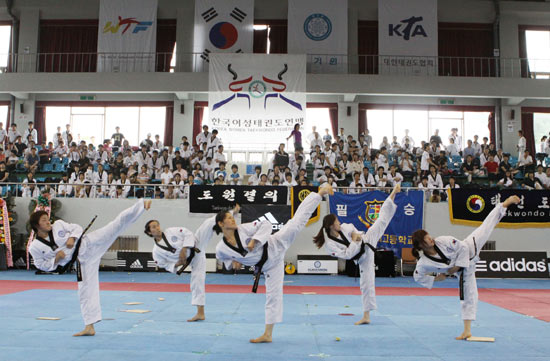
                From the time of the Goguryeo kingdom (37 BCE- 668 AD), when royal tombs were decorated with murals of figures in unarmed combat and guarded by statues of ancient warriors, martial arts have played a prominent role in Korean society. Historians have traced the evolution of Korea’s martial arts from this era, in which ancient forms such as subak and taekkyeon were practiced, to the mid-20th century, when modern taekwondo was formed. In 1971, taekwondo was designated Korea’s national sport, a decision that revealed its importance to the Korean culture and the Korean national identity. Since then, taekwondo has been recognized as the world’s most popular martial art. The incredible growth and worldwide popularity that taekwondo has experienced in the past 40 years has drawn international interest to the Korean peninsula. This was notably the case in the 1988 Seoul Olympics, and in the work of the Kukkiwon demonstration team as an ambassador of Korean culture. The spread of taekwondo has led to the spread of Korean culture and to increased awareness of the small country of Korea, long overshadowed by its giant neighbors in the far Eastern corner of Asia. More than just a competitive sport, taekwondo has helped in the globalization of the Korean culture, and in the redefinition of Korea’s role as a leading member of the international community.


The origin of Korean martial arts: hwarang warriors
The taekwondo movement first appeared on the Korean peninsula long before the development of taekwondo, with the rise of the hwarang warriors. Though not solely a military group, these young men became expert martial artists in Korean forms such as subak, and would later prove instrumental in the unification of the three kingdoms under the leadership of the Silla kingdom (Lazore). Much of the scholarly work about the hwarang, however, emphasizes not only their military prowess and skill in martial arts, but their close ties to Korea’s religious institutions (Lazore). While the hwarang curricula itself was based loosely on Korea’s ancient religions, a defining characteristic of the hwarang was their unfailing loyalty to the “Five Codes of Human Conduct.” These commandments were similar in concept to the Confucian and Buddhist ideals that were prominent among the elite in the Silla dynasty; a member of the hwarang exemplified qualities such as “humanity, justice, and courage,” while pledging “loyalty to his king, and filial love toward his parents,” laws which bring to mind the strict hierarchical relationships in Confucianism (Lazore). The reputation of the hwarang as devout religious seekers led some members to be regarded as incarnations of the Maitreya, the buddha who was supposed to “demonstrate the path of virtue” to humans in the future (“Who is Maitreya Buddha”). Due to the uprightness of the hwarang, the group’s diverse knowledge of fields such as religion, politics, and martial arts became an element of their virtuosity, and was tied into the image of the hwarang as “ideal leaders” who had attained the highest level in “traditional values, ethical and moral standards, fighting, and religion” (Lazore). The religious practices of the hwarang can easily be compared to those of the Shaolin monks, who similarly used kung fu and applied the martial philosophy in their spiritual practice. The hwarang are essential to any discussion of Korea’s martial arts history due to the role they played in uniting Korea’s martial arts philosophy with its religious culture, granting greater cultural significance and meaning to arts like subak.
Furthermore, martial arts like subak and later taekkyeon were frequently the subjects in Korean traditional art, demonstrating both the commonality of martial arts tournaments in Korean culture, in addition to the perception of these arts as not just a common pastime, but a beautiful tradition to be preserved and glorified for posterity. As early as the Goguryeo dynasty (37 BC- 668 AD), the Muyong-chong and Kalchuchong royal tombs were decorated with intricate murals of figures in armed and unarmed combat, supposedly practicing early forms of subak. These fighters were “meant to protect and amuse the buried king,” hinting at the popularity of martial arts for both recreation and defense in this early era (“History of Taekkyon”). One of the most famous Korean paintings from the 18th century—Korea’s Joseon dynasty—depicts a taekkyeon sparring match in the royal palace (“Origins of Taekkyon”). This painting portrays peasants, scholars, and government officials thronging together in the audience, entranced by the intensity of the tournament. This scene would have been highly unusual in Joseon’s rigidly hierarchical society; however, in the absence of written records on martial arts practice in the Joseon era, such paintings provide insight into the importance of martial arts to Korean culture, as a tradition that was enjoyed by, and could potentially unite, Koreans from all classes.
Fascinated by the rich culture and diverse traditions celebrated by the Korean people, American anthropologist Stewart Culin published a book titled Korean Games after a tour through Korea in 1895 (Capener). Images of taekkyeon tournaments were heavily featured in the book, suggesting that Korean martial arts were practiced throughout the Korean peninsula, and that these arts had great significance to the Korean people, something even a foreigner was able to identify. The importance of martial arts to the Korean people, and its place as a tradition representative of Korea’s culture therefore set the precedent for the development of Korea’s newest martial art--taekwondo.

The birth of global taekwondo in the lead-up to the Seoul Olympics
Immediately following Korea’s independence from Japanese Occupational rule, five different branches of martial arts sprang up in Korean society (Capener). After 36 years of “re-education” under the Japanese, in which the Korean people were forced to think of themselves as “passive,” and “coming from a tradition without a fighting spirit,” many Koreans turned to the traditional martial arts such as taekkyeon as a means of re-discovering their national identity and declaring their sovereignty (Harmon 22). The martial arts practiced in these years were similar to traditional Korean martial arts, with some influence from the styles of neighboring countries (22). Starting in the 1950s, however, the leaders of the separate kwans or schools of martial arts came together in order to standardize Korea’s fighting styles. Through their efforts, taekwondo—the art of the hand and foot—was born. From its inception, this new martial art was different from previous ones in its more international appeal; the International Taekwondo Federation (ITF) and World Taekwondo Federation (WTF), the first taekwondo organizations with branches in other countries, declared as their mission the “promotion of taekwondo outside Korea” and “the expansion and improvement of worldwide taekwondo” (Capener). By the early 1990s, taekwondo had become affiliated with 19 different regional and international tournaments in the Americas, Europe, Africa, and Asia (“World Taekwondo Federation”). However, this did not mean that taekwondo had strayed from the philosophy that characterized Korea’s former martial arts. On the contrary, taekwondo philosophy was imbued with much of the same spirit that had been present in the martial code of the subak-practicing hwarang warriors; in the official World Taekwondo Federation website, the taekwondo philosophy is suggested to be hongik-ingan, meaning the “universal wellbeing of mankind.” The International Taekwondo Federation similarly references every taekwondo practitioner’s duty to strive to “build a more peaceful world,” and to champion the causes of “freedom” and “justice” (International Taekwondo Federation). As a tradition rooted in the Korean culture and yet aimed at a broader audience, the global spread of taekwondo has been closely connected to Korea’s own path toward globalization. 
When the nascent World Taekwondo Federation and International Taekwondo Federation first began teaching taekwondo overseas, they were acting contrary to the sporting environment in Korea, where the competition level was “quite low” and its goals “quite humble” (Sanfilippo).  Though taekwondo continued to spread through organizations like the Pan-American Taekwondo Union and tournaments like the 1st European Taekwondo Championships, even becoming an Olympic sport in 1980, Korea was still considered a minor player in international sports competitions. Many nations in the Olympic Movement were thus surprised when Korea announced its bid to host the 1988 Summer Olympics; when the country managed to trounce more experienced contenders such as Japan and Canada to be elected as the host nation, the decision “stunned the Olympic world” (“Report on Planning and Organization”). While a confluence of factors finally contributed to Korea’s success, it is very likely that the country’s founding and management of a globally-practiced martial art formed the base on which its bid was established. According to the Official Report on Planning and Organization, the Secretary-General of the World Taekwondo Federation, Lee Kum-hong, spent the final few months before the decision was made, “tour[ing] North and Central America” and leading European nations, to lend his support to Korea’s campaign. In its released summary of the preparation period, the Korean government speculated that the global connections of the WTF president were the reason why many IOC members “began to show interest in Seoul” as a host city. The 1988 Seoul Olympics were undoubtedly a great boost to Korea’s sports, leading to improved facilities and training programs, but they also ignited Korea’s globalization, as Korea experienced increased global trade, foreign investments, and cultural exchange in the years following the Games (Sanfilipo). Ultimately, the wide recognition of taekwondo as an Olympic sport brought Korea—as a new member of the Olympic movement—the publicity and connections necessary to host an Olympic Games, an event that was hugely influential in Korea’s globalization, and to gain greater representation in and the respect of the entire sporting community.
Taekwondo as an ambassador for the Korean culture
With the Seoul Olympics as a starting point, the globalization of Korean culture, society, and economy has depended in part on the global network of taekwondo, in which taekwondo masters have acted as highly successful ambassadors for the Korean culture. In this movement, none have been more effective than taekwondo masters in groups such as the Kukkiwon demonstration team, which has travelled to over 100 countries since its foundation in 1974. In the UK, one such performance by the Kukkiwon team inspired a local blogger to write that the Kukkiwon members had “surpassed their human limits [during the demonstration]” and met with “thundering applause” (Han). However, this appreciation and the overwhelming interest in the team have been directed not only at the members’ taekwondo abilities, but the message they deliver as representatives of Korean cultural arts. After one such demonstration in Maryland, the students of a local taekwondo school were inspired to take trips to the closest Korean Cultural Center, to explore exhibits on Korean culture, traditions, and the history of the Korea-US Alliance (Citro). In an interview, the students’ taekwondo instructor expressed great pride at the “love…for Korea and its famous martial art,” that had been inspired by the demonstration and taekwondo training, and the students’ subsequent “eager[ness] to visit Korea even once in their lifetime” (Citro).
Recognizing the great role that taekwondo has had in stimulating Korea’s globalization, and improving its image as seen by other nations, the Korea government has recently begun to support the work of taekwondo masters abroad, encouraging them to expand their activities to promote the Korean culture. In 2009, the Presidential Council on Nation Branding summarized its efforts as part of then-President Lee’s global public relations campaign for Korea. In addition to “sending more taekwondo performance teams abroad,” the plan has entailed the development of “taekwondo-related [media],” and release of an “online taekwondo manual” (Kim 126). As the purported goal of the council was to “increase [Korea’s] soft power,” taekwondo has been an invaluable medium through which the Korean government has been able to replace any western views of “South Korea as less relevant or important,” relative to its neighbors, with images of the taekwondo philosophy being carried out around the world (129). By facilitating and enhancing the spread of taekwondo as a key component in Korea’s public relations campaign, the Korean government has taken advantage of the trend started by the Kukkiwon team, using the martial art as a representation of Korea historically and in modern times, to help the Korean culture gain visibility in the global community. One method through which the Korean government has attempted to do this is by sending taekwondo instructors in missions to underdeveloped nations. In 2011, one such troop of Korean soldiers was sent to Haiti with the task of teaching basic taekwondo skills, and “introducing Korean culture through songs and dances” to local youth (“A Korean Legacy in Leogane: Taekwondo”). Though the troop also worked for UN construction projects in the area, the Korean culture classes had a lasting impact on the Haitian youth, as many students later expressed gratitude to the soldiers for “sharing their knowledge of a discipline” that unites “self-defense” and “meditation” (“A Korean Legacy in Leogane: Taekwondo”). As taekwondo has readily come to be accepted as a true symbol of Korea, the good works of taekwondo masters worldwide, completed in accordance with the taekwondo philosophy, have inadvertently begun to shape international perceptions of Korea in its global engagements.
The taekwondo spirit as the Korean spirit
The role that taekwondo masters played, as ambassadors of Korean culture, in Korea’s Olympic bid has already been widely acknowledged by the Korean government; yet the influence of the taekwondo philosophy in determining the tone of the Olympics is a critical but often overlooked aspect of this event. In the lead-up to the games, the Korean government declared the Seoul Olympics first and foremost a venue for international dialogue, establishing three of the five main goals of the event toward the fulfillment of a global agenda (“Report on Planning and Organization”). This agenda included showing “compassion”—the Seoul Games were the first to occur almost parallel to the Paralympics, granting equal importance to disabled athletes—and paving the way for “future legacy”—Korea’s successful hosting of the event was meant to “inspire courage in developing countries… towards national development” (“Report on Planning and Organization”). Especially in recent years, the Olympics have become known as a commercial venture and gambit for the hosting nation (for instance, the 2008 Beijing Olympics was solely focused on presenting Beijing and its citizens in the best possible light), so many countries were perplexed by the extent of Korea’s externally focused-goals (“Official Report of the Beijing 2008 Olympic Games”). However, the reasoning behind this decision is made evident by a brief examination of the Korean culture, especially in its connection to martial arts philosophy. Since the reign of the Silla hwarang warriors, the ideal person in Korean society had been one who sacrificed himself for the achievement of peace among one’s friends, and demonstrated goodness and virtue. This ideal has continued into the modern day, with current taekwondo schools placing similar emphasis on the moral philosophy of inducing peace. Likewise, in the Official Report on the Seoul Olympics, the Planning Committee attests to “Korea’s orientation toward peace,” and the “excellence of traditional Korean culture,” as important factors in the Olympics planning process. To a certain extent then, it was the beliefs of Korean martial artists, which contributed to the nation’s “peace-oriented” values that would motivate Koreans to plan their first Olympics with a beneficent agenda.
Since then, the taekwondo philosophy promoted and practiced by taekwondo athletes worldwide has become a central part of Korea’s global image; for instance, taekwondo athletes in countries that suffer from gender inequality, such as Tajikistan, have been at the helm of the movement for social justice. Members of the NTKF (National Taekwondo and Kickboxing Federation of Tajikistan) have ardently spoken out to “advance the rights and equality of women” in Tajikistan—a country that historically did not provide women legal protection against domestic violence—through presentations and by encouraging women to learn taekwondo as a means of self-defense (Boboev). While a draft law abolishing this practice was adopted in 2012, taekwondo schools remain a refuge for Tajikistani women, a place where all athletes are considered equal, and the determination to advocate for social equity is instilled in every practitioner. Taking into consideration the previously discussed work of taekwondo instructors in communities in Haiti, it is clear that the athletes for this martial art have become champions for social minorities, and supported movements for the “universal wellbeing of mankind.” As these taekwondo masters have begun to truly taken on the role of cultural ambassadors for Korea, the worldwide image of Korea has come to encompass such movements for social advocacy, and Korea has, in turn, incorporated this advocacy in its own global activities, notably as discussed in the humanitarian focus of the Seoul Olympics.
With its ties to the taekwondo movement and adoption of the philosophy, Korea has gained the opportunity to work closely with international bodies such as the United Nations, for the achievement of shared international goals. In 2013, in recognition of the work of the taekwondo peace corps, and the World Para-Taekwondo Championships, the United Nations Office of Sports and Development Program (UNOSDP) signed a memorandum with the World Taekwondo Federation, promising to work towards “common objectives… promot[ing] sport-for-all and peace” (“UN Special Advisor). While this agreement made taekwondo a unique tool in the achievement of the goals of the UN, it concurrently opened the door for collaboration between Korea and the UNOSDP. As the headquarters of the WTF, South Korea was invited to host the UNOSDP’s flagship project, the bi-annual Youth Leadership Program, three times, more than any other nation. In the past two years, this program has provided youth leaders from over 20 different nations the opportunity to exercise their leadership abilities and become initiators of international exchange by engaging in sports with other globally-minded youth. The partnership between the international institution of taekwondo and bodies like the United Nations has thus conveyed on Korea the chance to nurture future world leaders, and gain an image as a nation conducive to international exchange. Had it not been for the fortitude of taekwondo masters to battle injustice in countries like Tajikistan, or the appraisal of world taekwondo leagues as a force for global change, it is unlikely that Korea would be in the position it is today, as an invaluable partner to the UN and a firm proponent of social acceptance.  

Conclusion
Considering the dual role of the hwarang warriors as military leaders and religious seekers, and the worldwide presence of taekwondo instructors, it is evident that martial arts not only have influenced Korean society throughout history, but also have represented the globally influential Korean culture. The development of taekwondo reinforced the importance of Korean martial arts, and it quickly became an ambassador of the Korean culture, granting the country greater power to move the international sporting community, and the opportunity to host monumental events such as the Seoul Olympics. These events globalized Korea’s economy and society. Taekwondo masters have played critical roles of representing Korean culture and advocating social equality and worldwide development. Consequently, they had a profound impact on Korea’s image, and also promoted the country’s position in international engagements. In order to understand current Korea in the world, it is critical to recognize the importance of its martial arts culture, and the philosophy underlining taekwondo.


Works Cited
“A Korean legacy in Leogane: Taekwondo.” Sport for Development and Peace. UNOSDP, 2012. Web. 19 May 2015.
Capener, Steven D. “The History of Modern Taekwondo in Korea.” Taekwondo: The Spirit of Korea. n.p, 2001. Web. 16 May 2015.
Citro, Marissa. “World Champion Taekwondo Students Escape the DC Heat to Befriend Korea.” Dynamic-Korea.com, 2012. Web. 20 May 2015.
Han, Jeon. “Kukkiwon Demonstration Team shows off Taekwondo moves to the world.” Korea.net, 2012. Web. 21 May 2015.
Harmon, R Barry. “The Origins of Korea’s Martial Unreadiness.” 5000 Years of Korean Martial Arts. Indianapolis: Dog Ear Publishing, 2007. 21-25. Ebook.
International Taekwondo Federation. International Taekwondo Federation, n.d. Web. 25 May 2015.
Kim, Doug. “Martial Arts and Martial Sports.” The Koreas. Ed. Mary Connor. Santa Barbara, CA: ABC-CLIO, 2009. 322-331. Print.
Lama Yeshe. “Who is Maitreya Buddha?” fpmt. Foundation for the Preservation of the Mahayana Tradition, 2015. Web. 31 May 2015.
Lazore, Courtney. “The Hwarang Warriors—Silla’s Flower Boys.” Dartmouth’s The Quarterly of East Asian Studies. Dartmouth’s The Quarterly, 2014. Web. 1 June 2015.
Boboev, Parviz. “Martial artists fight gender discrimination, violence in Tajikistan.” United Nations Population Fund. n.p, 2015. Web. 21 May 2015.
 “Mr. Dae Sung Moon.” Olympic.org. n.p, 2015. Web. 20 May 2015.
 “Organization and Planning Volume 1.” Seoul Olympics Official Report. IOC Library, n.d. Web. 22 May 2915.
“Origins of Taekkyon.” Over View. n.p, n.d. Web. 21 May 2015.
“History of Taekkyeon.” Taekkyeon. World Public Library, n.d. Web. 19 May 2015.
Passport to Korean Culture. Seoul: Korean Culture and Information Service Ministry of Culture, Sports and Tourism, 2011. Ebook.
Sanfilippo, Jonathan. “Two Decades after the Seoul Olympics.” The Korea Times, 2007. Web. 31 May 2015.
Southwick, Ronald A. “A Brief History of Taekwondo.” Michigan State University, n.d. Web. 15 May 2015.
”Taekwondo.” Korea.net. n.p, 2015. Web. 21 May 2015.

“UN Special Adviser signs partnership agreement with the World Taekwondo Federation in Manchester.” Sport for Development and Peace. UNOSDP, 2013. Web. 19 May 2015. 

Face to face with the Ebola Virus (10.10.14)

The latest villain of news media has begun to penetrate the deepest fears of Americans. Is it Ronan? Kim Jong-un? No, it’s the ebola virus. The highly contagious disease that infected almost 6,000 and killed over 2,000 in Western Africa has left America terrified for its health. But perhaps these fears are not justified; could it be that our tendency to misread international events has made us into parochial frogs in a well?
            According to statisticians, the answer, surprisingly, is “no.” The outbreak that first struck Guinea in December of last year has exploded into the most serious case of the disease to date; the current number of cases triples that of the first outbreak in the Democratic Republic of Congo in 1976, or the brief scare in Uganda at the turn of the century. The Centers for Disease Control and Prevention reported two weeks ago that the total civilian death rate by January 2015 will reach 11,000 at the very least, and 1.4 million in the worst case scenario.
            However, as researchers are not the ones directly exposed to the virus, it is critical to consider the perspective of Africans. For those living in the disease-ravaged African coast, ebola has disrupted every aspect of daily life. Not only has the under-staffed and under-funded health care system refused to treat all but ebola cases, but public services, including schools in Guinea, Liberia, Sierra Leone, and Senegal have closed out of fear of spreading the contagion. Local residents commented to BBC on their frustration at the situation: “I’m against the government decision to [close all schools]… would you ask students to stop going to churches and mosques as well?” Though the government cannot prevent locals from gathering, it has every power to deny them access to basic medical aid. Stories of first-time mothers dying from pregnancy complications, or seniors battling desperately with the common flu have horrified Americans. In each of these situations, the victim died alone, as their suffering was deemed “not as important” as that from the ebola virus.
Even from the view of the medics themselves, the epidemic is a worst nightmare come true. Many of the workers are volunteers who raced to answer the world-wide plea for medical personnel. What the job description did not address though, was the fact that there is no cure or vaccine, or that most hospitals are ill-equipped to treat ebola. Volunteers are in contact with victims for far more than the recommended number of hours, and easily contract this fluid-borne illness. However, most infected volunteers do not have to worry about being refused medical aid. Dr. Rick Sacra contracted the disease in Liberia last month, but six days later, he was receiving expert care in the United States. For Americans at least, “the care [is] so excellent, so speedy,” and a world apart from the situation that faces African victims.

            Then do we have any reason to fear an ebola outbreak in the US? Unless otherwise noted, our insurance money can more than easily contain any outbreak, in the case that one does occur in the United States. The real concern, though, is our blatant ignorance of the African health care. Why did it take a reoccurrence of the ebola epidemic for us to take our eyes off our own health care system? Before more deaths can take place, it is high time that we paid more attention to lacking medical facilities around the world, and fulfilled our obligation to improve international health. Perhaps then we will be less inclined to believe exaggerated news reports, and disperse the self-absorbed mist that clouds our perception of the world. Until then, Americans can be said only to be frogs in a well, unaware of the reality of the ebola virus in Africa, or most any other conflict beyond our country borders.

An Interview with Malala Yousfazi (11.6.14)

In 2012, a “mockingjay” entered the international stage. When the Taliban shot and critically injured this 15-year old girl, her voice was immediately amplified across the world as a powerful call for youth education. Her name is Malala Yousafzai. One afternoon, I was sitting in my room, surrounded by recent magazine clippings of Malala, when she paid me a visit. As if her passion and strong will had risen out of all of the articles, I envisioned her spirit standing in front of me, determinedly sharing her life’s message. Here is our interview.

Me: Malala, you’ve received the Noble Peace Prize, met with Obama, the Queen of England, and are talked about throughout the world. How does it feel to be looked up to by so many girls & children around the world?
Malala: It’s a real honor, but a strange feeling for me, because I’m really just like all of you. Even after being shot by the Taliban, I am still the same girl I was before; a teenager from Pakistan that wanted to go to school to be with her friends and receive an education.

Me: Are you scared of being targeted by the Taliban again?
Malala: Now, I only desire for all youth, even the children of the Taliban to have equal opportunities & the right to education. So you can say that, even though my view has not changed, I am thankful as the Taliban boy that shot me raised my voice, which is only one of the many for unprejudiced education, to the international community.

Me: What motivates you to continually speak out on human rights?
Malala: Ever since I was young, my dad has always encouraged me to speak out about my rights. I’m sure all of you, even as Americans, learn one key thing from our parents. Mine was that I had the right to be educated, and to have as many opportunities as my two younger brothers did. When I began blogging for the BBC Urdu, I was determined to receive an education despite all of the violence that surrounded me, and that desire has been with me even after I was shot. Now, I am receiving an excellent education in the United Kingdom, but whenever I think that another girl or another boy may be suffering from the same unequal opportunities I faced, I am filled with a burning desire to help them, and to make their voice heard to the international community.

Me: Do you have any advice for how members of the Saint Francis High school community can work to make a change for girls’ and boys’ education?
Malala: I greatly admire the environment in which many of you have grown and received an education. But let me ask you this: what are your plans for the future? My dream is for all children to be able to ask themselves that question without criticism or attack. If you have school clubs that allow you to stand up & speak out on the fight for children’s rights, join them to strengthen the campaign for equal education of all children. One child, one teacher, one pen, one paper can change the world. If we really want world peace, education will spark the revolution.

                With her last words ringing in the air, Malala’s spirit faded away from my room. But where she had just been standing, I could still sense a beacon of life, and I felt the intensity of her life’s dream welling up inside of me. Seeing in person a teenager, just like us, that had changed the world, I thought she had the power to make anyone see beyond the well.

Why We Need to Know about East Asia (4.20.15)

East Asia. The home of k-pop, j-pop, and Asian idols. The promised land of milk tea and kimchi. The region in which our ipads are manufactured and shipped, along with thousands of other “Made-in-China” goods. From the era of Western expansion in the 19th century, East Asian exports and orientalism have influenced the culture of the US. But while our counterparts in the region are well-versed in American history and politics, how many of us can name the current Japanese emperor, or identify the reasons for the continuing division of Korea? As statistics frequently point to this region as the future powerhouse of the 21st century (often called the “Asian century”), it’s time we looked beyond our borders, to our rising neighbors across the Pacific.
            Politicians most commonly group China, Taiwan, Japan, and the two Koreas under the broad term “East Asia.” This label encompasses three of the “Asian Tigers”—nations and metropolitan areas where meteoric industrialization have made them paragons of economic success. In the past year, however, President Obama has commonly referenced the East Asian countries, not for their economic rise, but as a model for youth education.
            Despite the US’s global superpower status, it has consistently and quite publicly scored poorly in international student assessments, like the PISA. While cities like Shanghai or Seoul have come out at the top, the US has scraped by in the mid-20s, low-30s mark. Acknowledging this shortcoming, President Obama has frequently cited the need to copy East Asian education methods: “if they can do that in South Korea, we can do it here.” But what exactly is happening in Chinese and Korean schools? The most obvious disparity between East Asian and American education is the degree of invested time and money. In Korea, all students attend afterschool academic classes, called “hagwon,” from the time they get out of school, late into the evening. Different hagwon are dedicated to teaching math, science, reading, and English, before the material is taught in schools. While the government spends relatively little on education, the ratio of private to public expenditures is higher in South Korea and Japan than in any other nation in the world. The secret to their academic excellence is not money or time, but culture. East Asia possesses a history of academic rigor that distinguishes it from the US. Ingrained within Asian cultures are Confucian beliefs concerning the personal returns on education. Especially in Korea, this heralds back to the days when one’s marks on an annual government exam dictated one’s career. Without a similar background of academic rigor, the US will find it challenging to compete with the academic dragons of the East.
            East Asia also poses an important consideration to the US in the context of global security. Though mostly ignored by American news outlets, cultural and territorial disputes are still raising tensions in Asia. Many of these conflicts stem from the legacy of imperial Japan in WWII, and the claims of the current government to islands along the Eastern and Southern coast of Korea and China, respectively. The Chinese government has also entered into frequent clashes with Koreans over cultural monuments and heritage sites near the Korea-China border, which were erected by ethnic Koreans during Korea’s expansionist “Three Kingdoms” era. And despite optimistic speeches concerning reunification and an end to armed conflict, North Korea continues to express its concern over military exercises conducted between the US and South Korea, leading to its pursuit of nuclear capabilities. Our nation depends heavily on diplomatic relations and trade with its allies in East Asia; unless we learn to pay attention to the situation across the sea and acknowledge the historical and cultural background, we may be left behind by the most dynamic region in the world.
            The idea of broadening one’s perspective and “looking outside the walls of a well” (hence the title of this column), also comes from Chinese and Korea folklore, a tribute to the oft overlooked influence that East Asia has had in American culture.

Week 3 Response Paper: Religion in the Modern Human Rights Regime

The roots of human rights are beyond a modern, western invention. There is a surfeit of scholarly work that suggests the opposite; in this paper, I will use the Western Enlightenment idea of human rights described as “subjective rights,” claims, or freedom vested in a person (Witte 20-21). In their argument for the development of this concept of human rights in the Western enlightenment, some scholars have suggested that Asian values, historically, have placed greater emphasis on order and economic development, making the concept of human rights less relevant to Asian cultures compared to those of the West (Sen 9-10). However, one must note that even those religious traditions that do not seem compatible with a respect for universal human rights in fact demonstrate an appreciation of the rights and responsibilities of each individual. In Hinduism, the caste system, rather than being a hierarchical order of oppressive social classes, champions the idea of egalitarian complementarity, in which the unique contributions of each class to the interdependent community are noted through reciprocal relationships (Martin 270-273). Furthermore, the Confucian concept of strictly-defined relationships between members from different sectors of society reveals an emphasis on moral self-cultivation in order to establish trust and stronger relations within a community of people, who are once again seen to be social and interdependent (Twiss 284-286). Scholars such as Leo Strauss who argue that the discussion on human rights was established during the Enlightenment emphasize that the language of human rights cannot be found in any context outside modern western traditions (Witte 21). In their references to the interrelated, interdependent community, Asian religions, specifically Buddhism, transcend the Western understanding of human rights by providing a clear explanation for why everyone must be treated with compassion, and their rights should be respected—one’s treatment of others is part of the karma that determines the nature of one’s future lifecycles in the endless process of evolution (Thurman 108). Sen adds that the Hindu teachings demonstrate a keen understanding of personal liberty and toleration of others, at least in the privileges held by the upper classes (Sen 21-22). The fact that these non-western traditions approached the concept of human rights with a different viewpoint, or preached only select components of said ideals, does not alienate them from human rights talk, or prevent them from being the religious roots for these rights. 

Week 2 Response Paper: Religious Roots of Rights

The roots of human rights are beyond a modern, western invention. There is a surfeit of scholarly work that suggests the opposite; in this paper, I will use the Western Enlightenment idea of human rights described as “subjective rights,” claims, or freedom vested in a person (Witte 20-21). In their argument for the development of this concept of human rights in the Western enlightenment, some scholars have suggested that Asian values, historically, have placed greater emphasis on order and economic development, making the concept of human rights less relevant to Asian cultures compared to those of the West (Sen 9-10). However, one must note that even those religious traditions that do not seem compatible with a respect for universal human rights in fact demonstrate an appreciation of the rights and responsibilities of each individual. In Hinduism, the caste system, rather than being a hierarchical order of oppressive social classes, champions the idea of egalitarian complementarity, in which the unique contributions of each class to the interdependent community are noted through reciprocal relationships (Martin 270-273). Furthermore, the Confucian concept of strictly-defined relationships between members from different sectors of society reveals an emphasis on moral self-cultivation in order to establish trust and stronger relations within a community of people, who are once again seen to be social and interdependent (Twiss 284-286). Scholars such as Leo Strauss who argue that the discussion on human rights was established during the Enlightenment emphasize that the language of human rights cannot be found in any context outside modern western traditions (Witte 21). In their references to the interrelated, interdependent community, Asian religions, specifically Buddhism, transcend the Western understanding of human rights by providing a clear explanation for why everyone must be treated with compassion, and their rights should be respected—one’s treatment of others is part of the karma that determines the nature of one’s future lifecycles in the endless process of evolution (Thurman 108). Sen adds that the Hindu teachings demonstrate a keen understanding of personal liberty and toleration of others, at least in the privileges held by the upper classes (Sen 21-22). The fact that these non-western traditions approached the concept of human rights with a different viewpoint, or preached only select components of said ideals, does not alienate them from human rights talk, or prevent them from being the religious roots for these rights.